What Is The Primary Cause Of Failure For Strategic Initiatives?

Quick Answer: The primary cause of failure for strategic initiatives is treating strategy as a plan to approve rather than a function to lead.
Most strategic initiative failure is not caused by one execution mistake. It is caused by the absence of a working system around the initiative: weak alignment, unclear ownership, underfunded priorities, poor communication, and no operating cadence for review and adjustment.
Execution is where the failure becomes visible. The root problem usually starts earlier.

The Real Problem Usually Starts Before Execution
When a strategic initiative stalls or collapses, the instinct is to look at execution. Missed deadlines. Confused teams.
Projects that consumed months without producing results. Those are real problems, and they deserve attention.
But they are often symptoms of something that went wrong earlier in the process.
The primary cause is usually a weak strategy system: poor alignment, unclear ownership, limited resources, weak communication, and no regular rhythm for review.
Strategic initiative failure rarely announces itself early.
The initiative may have launched without a clearly defined problem.
The leadership team may have left the planning session believing they were aligned when they were not.
The work may have competed with daily operations and lost. Resources may have been promised but never committed.
Strategy research has repeatedly found that well-formulated strategies often fail not because the idea was wrong, but because leaders did not translate the idea into tradeoffs, owners, and operating decisions.
A good planning process does not only produce a plan. It creates the conditions for better decisions and stronger execution.
Without those conditions, even a compelling initiative can lose momentum before it gains any.
The Primary Cause: Strategy Is Treated As A Plan, Not A Function
A Many leadership teams treat strategy as something they complete during an annual session.
The team gathers, agrees on priorities, approves the document, and returns to the same operating patterns as before.
That is where failure often begins.
A strategic initiative needs a working system around it.
Without that system, it will compete with daily business demands and lose. That system has several components, and when any one of them is missing, the initiative drifts:
- Clear problem framing so the team knows what it is actually trying to solve
- Leadership alignment that goes deeper than heads nodding in a room
- Resource allocation that reflects stated priorities
- Ownership, not just responsibility assigned by default
- Communication so people throughout the organization understand what the initiative means for their work
- Review cadence so progress can be measured and direction adjusted
- Adjustment when reality changes, rather than holding to a plan that no longer fits
This aligns with Josean Arroyo Pont's view that when strategy is not treated as an ongoing function, it eventually reverts to a low-value task.
That reversion is quiet. Teams stay busy.
Reports get filed. But the initiative loses its connection to how the business actually makes decisions and moves.
Strategy should stay alive inside the business. It should guide choices, shape tradeoffs, and give leaders a discipline for adjustment when conditions change.

Execution Is Where The Failure Becomes Visible
Execution gets blamed because it is visible.
Missed deadlines are visible. Unclear ownership is visible. Stalled projects are visible.
Teams moving in different directions are visible. Those failures are real, and they matter.
But visible failure is not always where the problem started.
When strategy execution problems surface, the better question is often: did execution fail, or did we give execution a weak strategy to carry?
An initiative may have launched without a clear strategic question behind it.
Leaders may have avoided naming hard tradeoffs in order to keep the planning session comfortable.
The company may have assigned responsibility without the authority or resources to act.
The initiative may have sat alongside ten other priorities with no clear signal of which one actually mattered most.
In those cases, execution was not the root cause. Execution was simply where the consequences became impossible to ignore.
When a leadership team can see the problem clearly at that level, they are in a much better position to ask the right questions.
Not just how do we execute better, but what did we fail to get right before execution began.


False Alignment Is One Of The Most Dangerous Causes Of Failure
Leadership teams often leave planning sessions believing they are aligned.
In most cases, that belief is sincere. But sincerity is not the same as shared understanding.
False alignment happens when leaders use the same words but mean different things.
It happens when no one challenges the underlying assumptions because the meeting feels like it is going well.
It happens when hard tradeoffs stay unspoken because naming them would create tension.
It happens when each department quietly interprets the strategy through the lens of its own priorities.
The result is a plan that everyone approved and no one is truly executing in the same direction.
This is one of the clearer patterns in why strategic plans fail. The conversation looked productive. The output looked solid. But the alignment was shallow.
In Josean Arroyo Pont's view, a strategic conversation is not just a meeting.
It requires time, listening, reflection, debate, and a shared story that leaders can carry into the organization.
A meeting that moves too quickly through the hard questions may produce agreement that does not hold when the real work begins.
Good planning facilitation matters here precisely because the value is not only agenda management.
The value is creating the conditions for honest, useful conversation before the company commits to the next initiative.
The Slide Deck Can Create A False Sense Of Clarity
The slide deck is not the enemy. It is a tool.
The problem starts when leaders confuse the presentation of strategy with the practice of it.
A polished document can make a plan feel more complete than it is. The pages look organized.
The language sounds confident. The team is satisfied with the output and ready to move on.
But a good strategy document should force the leadership team to answer harder questions.
What are we choosing, and what are we not choosing? Who owns the work? What needs funding? What needs to stop? How will we know if this is working? When will we review and adjust?
Failed business strategies often have something in common: they looked complete on paper but lacked the substance those questions require. The structure was there. The specificity was not.
A polished plan without ownership becomes corporate theater.
It gives leaders the feeling of having addressed something without the accountability that would make it real.

Weak Problem Framing Sends The Initiative In The Wrong Direction
Many strategic initiatives fail because the team starts with the wrong problem.
"We need more revenue" may be true. But it is not a strategic problem. It is a symptom.
The real issue could sit in weak market positioning, poor pricing confidence, low sales discipline, unclear customer fit, too many low-margin offerings, operational limits, or capability gaps inside the leadership team.
When the problem is framed too broadly, or too quickly, the initiative that follows addresses the surface level.
Teams work hard on the wrong thing. Time and capital get allocated to a solution that cannot solve the actual challenge.
Useful problem framing requires slowing down.
It requires root cause analysis before motion. It requires the leadership team to sit with discomfort long enough to name what is actually happening, not just what is visible.
Without that discipline, strategy implementation begins on a faulty foundation.
The company commits people, capital, and attention to a solution that cannot solve the actual challenge.


Culture Can Reject A Strategy Before The Work Begins
Strategy is written in structured rooms. It is executed by people inside real organizations.
Those people carry habits, incentives, fears, loyalties, and assumptions built over years of working inside the same system. If the culture rewards the old behavior, the new strategy will struggle, regardless of how clearly it is written.
A company may say it wants growth but still punish risk. It may say it wants accountability but avoid hard conversations.
It may say it wants speed but route every meaningful decision through the same bottleneck.
These are examples of behavioral barriers that leadership alignment conversations need to surface.
Strategy requires more than analysis. It requires leaders to shape the conditions where people can act differently, and to do that with enough honesty to acknowledge where the current culture is working against the stated direction.
This is where people, organization, and governance issues often intersect with strategic failure.
The leadership team may have a clear direction and still find that the organization is not built to carry it.
Capability gaps compound the problem.
An initiative may call for skills the company does not have, or for a way of working that the existing structure does not support.
A Priority Without Resources Is Just A Preference
This is one of the more predictable ways strategic initiatives fail.
Leaders call something a priority but do not fund it, staff it, or protect it from competing demands.
A strategic initiative needs capacity. It needs budget, time, talent, decision rights, leadership attention, and permission to stop lower-value work.
When none of that changes, the initiative will compete with everything else on the calendar and eventually lose.
Resource allocation is a test of whether stated strategy reflects real strategy.
If the money, people, and time are not following the declared priorities, then the priorities on the page are not the actual priorities of the organization.
Leadership accountability becomes hard to sustain when the resource model contradicts the stated direction.
Strategy should force choices. If everything remains a priority, nothing is truly strategic.
The leadership team that makes that distinction clearly, and communicates it honestly throughout the organization, is the one that gives its initiatives a real chance to succeed.
Understanding financial resources and how they connect to stated direction is one of the clearest signals of whether a strategy is being treated as a function or as a document.

Why Strategic Planning Facilitation Matters
The planning conversation shapes everything that follows.
A leadership team that does not get that conversation right will spend the rest of the year managing the consequences.
A good facilitator does not simply keep time.
The facilitator helps the leadership team clarify the strategic question before the initiative is designed.
The facilitator surfaces disagreement before it becomes misalignment. The facilitator helps leaders name tradeoffs, define ownership, and connect strategic direction to execution decisions.
For Sinfonica Strategies, this work connects to the deeper strategy function.
The issues a leadership team needs to confront may sit in financial resources, people and governance, market position, or core competencies.
The role of the planning process is to bring those realities into the room before the company commits to the next initiative.
For leadership teams entering a serious planning cycle, our
strategy planning consulting services help turn the conversation into clearer priorities, defined ownership, and realistic next steps that leaders can actually carry forward.
How Sinfonica Strategies Helps Leadership Teams Strengthen Strategic Initiatives
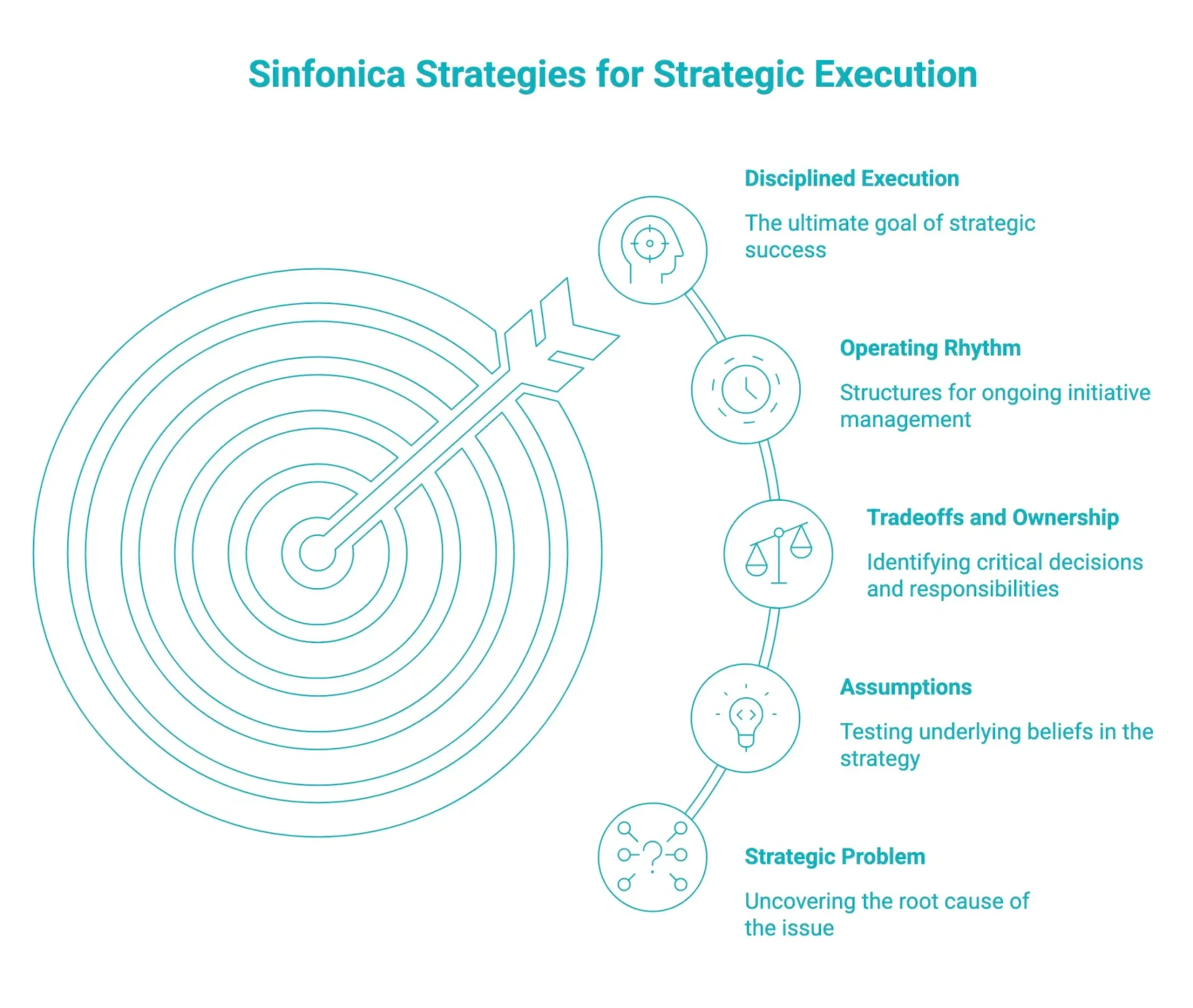
Sinfonica Strategies works with leadership teams to identify where a strategic initiative is weak before it consumes more time and capital.
That work often starts with clarifying the real strategic problem behind the stated priority.
It includes testing the assumptions the leadership team brought into the planning process.
It means identifying where tradeoffs need to be named, where ownership is unclear, and where resources are not yet matched to direction.
From there, the work becomes about building the operating rhythm that keeps the initiative alive inside the business. Review cadence. Clear accountability.
A way to adjust when market conditions change or when early assumptions prove incomplete.
The goal is not to add a layer of process.
The goal is to help leadership teams move from intent to disciplined execution, with the clarity and structure that makes execution possible.
Strategy Has To Be Led After The Meeting Ends
A A strategic initiative does not fail only because people did not work hard enough. It fails when the company does not build the leadership system around it.
The conversation matters. But the conversation must produce shared meaning, clear choices, and real movement.
A planning session that generates a polished document and shallow alignment leaves the actual work undone.
The companies that execute well treat strategy as a continuous function.
They return to the question. They review progress against an operating cadence.
They adjust when the evidence calls for it. They fund what they say is a priority.
That discipline does not happen automatically. It has to be built, and it has to be led.
If your leadership team is preparing for a serious planning cycle, learn how
Sinfonica Strategies' strategy execution consulting services can support the work.

What Is The Primary Cause Of Failure For Strategic Initiatives?
The primary cause is usually the absence of continuous alignment, ownership, resources, communication, and review rhythm.
Execution may be where the failure becomes visible, but the deeper problem often starts earlier, when the leadership team has not clearly defined the real problem, named the tradeoffs, or connected the initiative to how the business actually operates and makes decisions.
Why Do Strategic Plans Fail Even When The Idea Is Good?
Good ideas fail when leaders do not translate them into tradeoffs, owners, resources, and operating decisions.
A good idea still needs a working system around it.
Without clear ownership, adequate funding, honest alignment, and a rhythm for review, even a compelling strategic concept will lose momentum before it produces results.
What Are Common Strategy Execution Problems?
Common strategy execution problems include unclear priorities, weak accountability, poor communication across the organization, cultural resistance to new ways of working, limited resources against stated commitments, and the pressure of competing daily work.
Many initiatives also suffer from false alignment at the leadership level, where leaders agree on the plan but interpret it differently once the work begins.
How Can Leadership Teams Improve Strategic Alignment?
Alignment improves when leaders move past surface-level agreement and into honest conversation.
That means sharing definitions of success, naming tradeoffs openly, establishing clear decision rights, and building a regular review cadence so the team can surface misalignment before it becomes a missed deadline.
It also means being willing to revisit direction when reality changes.
How Can Strategic Planning Facilitation Help?
Facilitation helps the leadership team frame the right problem before committing resources.
A good facilitator surfaces disagreement, slows the team down enough to test assumptions, helps leaders name tradeoffs, and connects strategic direction to ownership and execution.
The result is a planning conversation that produces something real, not just a document that looks organized.
Thinking Through Whether A Fractional CSO Is The Right Fit?
If your company needs clearer priorities, stronger leadership alignment, and a more disciplined path to execution, Sinfonica's Fractional Chief Strategy Officer services may be the right next step.
If you would rather talk it through first,
start a conversation with us, and we can help you figure out what your business actually needs to stay in rithym.

More From The Journal


Share this article